Summary
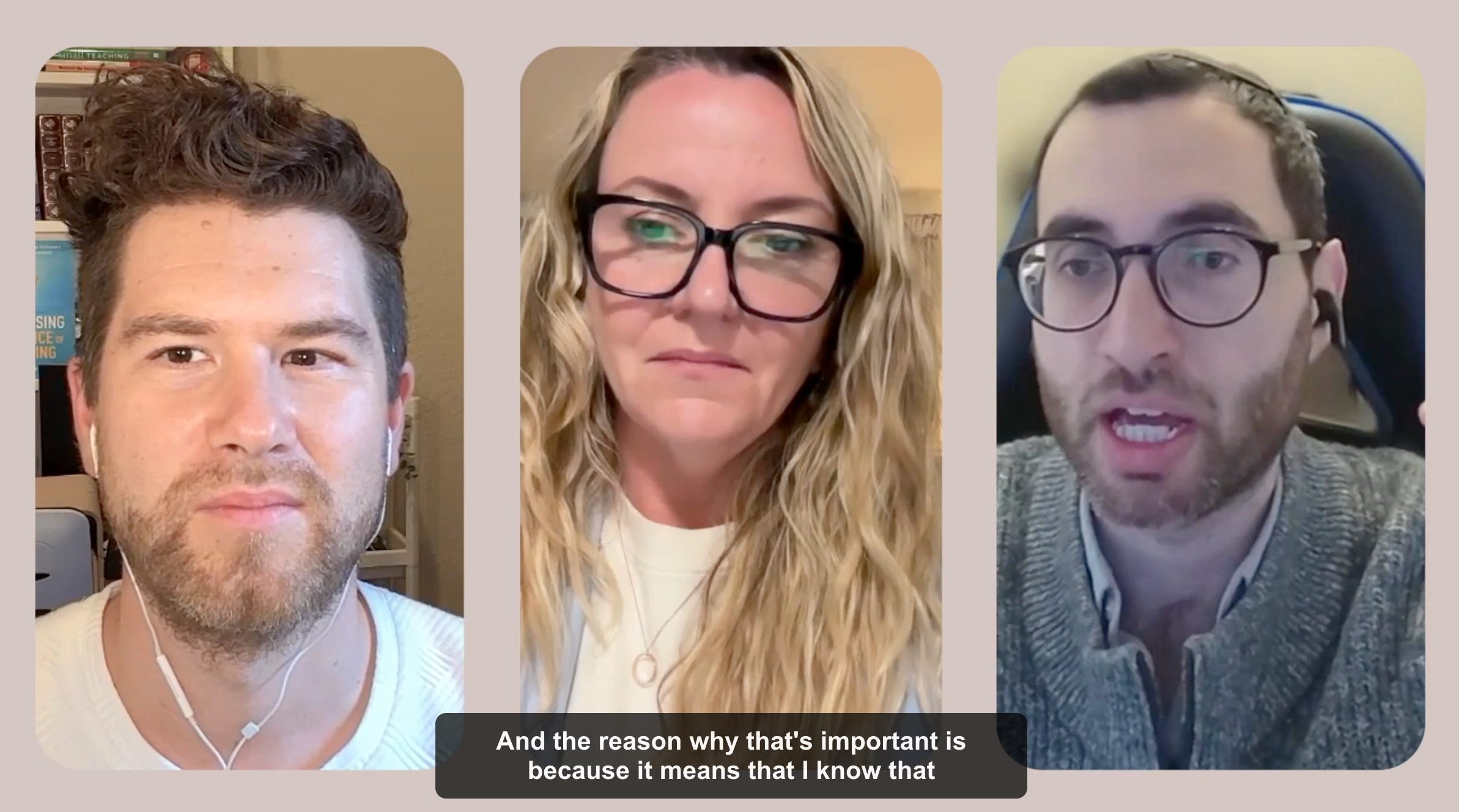
In this special episode of Chalk Dust, Nathaniel Swain and Rebecca Birch sit down with Adam Boxer to explore the thinking behind Carousel Teaching’s new video library. Rather than simply showcasing polished classroom clips, Adam explains how the platform is designed to pair tightly curated footage with explicit professional learning, commentary, and guidance so teachers understand not just what works, but why. The conversation focuses on one deceptively small but powerful domain of classroom craft: behaviour, transitions, and teacher presence.
Using clips from Adam’s own classroom and from colleagues Abby and Jack, the episode examines how teachers can prevent disruption before it starts through eye contact, body positioning, clear instructions, visible scanning, and carefully calibrated countdowns. Adam argues that strong classroom culture is not built through friendliness or vague notions of “relationships” alone, but through clear routines, consistent expectations, and precise, replicable moves. Across the discussion, the hosts reflect on what makes video-based professional learning useful: the chance to see normal classrooms, normal friction, and the specific choices that make lessons run smoothly.
Mentioned resources and explainers
Carousel Learning
Carousel Learning is Adam Boxer’s retrieval practice platform for students. It is designed to support retrieval and checking for understanding through structured classroom routines and digital tools.
Carousel Teaching
Carousel Teaching is the professional learning platform attached to Carousel Learning. It combines video exemplars, commentary, quizzes, and courses on specific aspects of classroom practice such as questioning, mini whiteboards, lesson starts, and behaviour management.
Turnaround school
Adam explains that the Totteridge Academy (more here), where the videos were filmed, is not a selective or “startup” school built from scratch with ideal conditions. It is a turnaround school: a previously low-performing school that has significantly improved. This matters because the strategies shown are intended to feel achievable in ordinary school contexts.
Be seen looking
A technique Adam links to Teach Like a Champion. It is not enough for a teacher to scan the room; students need to know they are being scanned. Visible attention helps prevent disruption before it begins.
Anticipate triggers
A strategy for preventing predictable moments of chaos. For example, if the phrase “pack up” tends to trigger movement too early, the teacher structures instructions to avoid that premature response.
Break eye contact
One of Adam’s highly specific behaviour techniques. After giving a correction, the teacher does not linger, negotiate, or invite backchat; they break eye contact and move on, signalling certainty and preventing escalation.
Circulation and the “crab walk”
Adam challenges the idea that teachers should constantly wander while addressing the class. Instead, he argues that movement should be purposeful and timed carefully, especially during independent practice. His “crab walk” describes circulating while keeping the body square to as many students as possible and the eyes up, maintaining oversight of the room.
Metronomic and non-metronomic countdowns
The episode closes with a close look at countdowns. Adam distinguishes between evenly timed countdowns and flexible ones that adapt to the task. The key principle is that countdowns should preserve urgency while still being fair and achievable.
Takeaways
Video-based professional learning is most useful when it is paired with explanation, commentary, and shared language about what teachers are seeing.
Teachers benefit from seeing normal classrooms, including moments of friction and correction, not just idealised footage.
Strong behaviour management is often proactive rather than reactive: positioning, scanning, timing, and clarity matter before correction is ever needed.
“Relationships” are valuable in themselves, but they are not a sufficient explanation for orderly classrooms.
Students do not behave simply because they like a teacher; clear routines, boundaries, and expectations still matter.
Teacher presence is communicated through body position, eye contact, and visible monitoring as much as through words.
Circulation is most effective when it is purposeful and timed well, rather than constant wandering during teacher talk.
Precise strategy names such as “be seen looking”, “anticipate triggers”, and “break eye contact” make coaching and implementation more actionable.
Countdowns can support pace and urgency, but they need to match the actual demands of the task.
Excellent classroom routines balance warmth, fairness, and high expectations.
Listen or view, and support our work
📨 Substack — sign up
🍏🎧 Apple Podcasts — like, review and follow
🎵💚 Spotify — follow and rate
📺🔔 YouTube — subscribe and like
✍️ Rebecca’s Substack — read more
✍️ Nathaniel’s Substack — read more
Keywords
Carousel Teaching, Carousel Learning, Adam Boxer, classroom video library, professional learning, behaviour management, teacher presence, transitions, mini whiteboards, be seen looking, anticipate triggers, break eye contact, circulation, crab walk, countdowns, pace, classroom routines, instructional coaching, classroom craft, evidence-based teaching