Summary
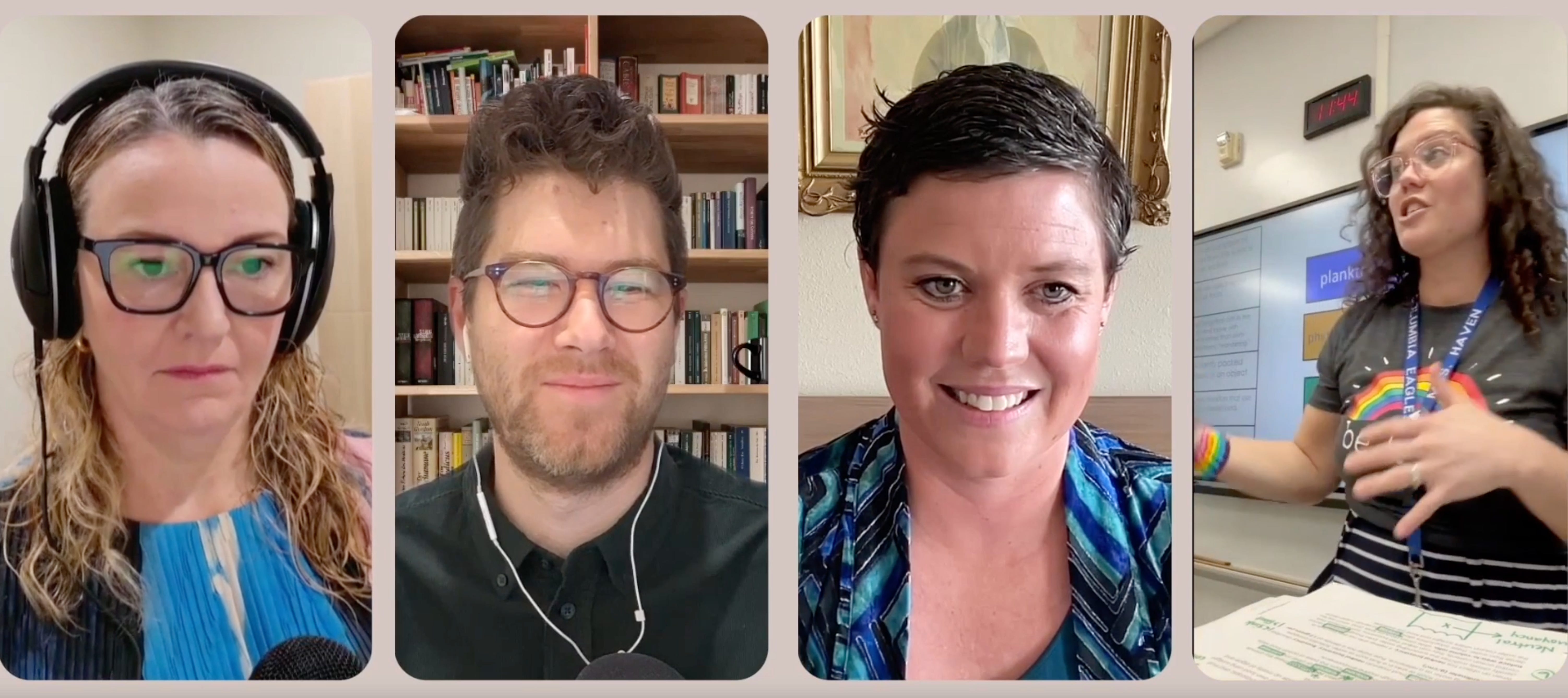
In this episode of Chalk Dust, Rebecca Birch and Nathaniel Swain are joined by STEM educator Amber Haven to explore what happens when explicit instruction meets genuinely engaging hands-on learning. Using footage from Amber’s middle-school STEM classroom, the discussion follows a lesson on neutral buoyancy, revealing how carefully designed routines allow practical investigations to remain cognitively demanding rather than descending into chaos.
Amber demonstrates how retrieval practice, mini-whiteboards, Six Bricks, gesture, choral response and explicit behaviour routines work together to create classrooms where every student is thinking. Throughout the episode, Rebecca, Nathaniel and Amber discuss the importance of background knowledge, continuous checking for understanding, purposeful transitions, differentiation without lowering expectations, and designing practical activities that provide immediate feedback. The conversation highlights how high-quality classroom routines free students to focus on learning rather than logistics, making complex scientific concepts accessible through deliberate instructional design.
Mentioned resources and explainers
Amber Haven
Amber Haven is a STEM educator with more than 16 years of classroom experience and a strong focus on translating cognitive science into practical classroom strategies. She has presented at ResearchED conferences across the United States and at the Thriving Educators Summit, and her work has been featured by The Learning Scientists and in Powerful Classrooms by Patrice Bain.
Retrieval Practice
Throughout the lesson, Amber demonstrates retrieval as an ongoing classroom habit rather than a single lesson component. Students repeatedly retrieve knowledge through mini-whiteboards, questioning, gestures, closed sentences and practical activities.
Mini Whiteboards
Mini-whiteboards allow every student to participate, provide immediate formative assessment, and make thinking visible. Amber discusses the routines required to use them fluently throughout a lesson.
Six Bricks
Six Bricks is a hands-on retrieval strategy that uses coloured Duplo bricks to sequence concepts, definitions or problems. Students retrieve vocabulary while constructing a coloured stack, allowing rapid checking for understanding and high levels of engagement.
Continuous Checking for Understanding
Rather than reserving checks for understanding for isolated moments, Amber embeds them throughout explanations, transitions and instructions, ensuring students remain cognitively engaged from beginning to end.
Gesture and Dual Coding
The episode explores how gesture, movement and simple physical cues support memory and retrieval—even with older students who may initially resist participating.
Differentiation
Amber demonstrates how differentiation can maintain common learning goals while adjusting the amount of work or level of support individual students receive, rather than lowering expectations or creating entirely different tasks.
Practical Science with Explicit Instruction
The discussion explores how carefully sequenced demonstrations, clear success criteria and explicit routines allow practical science lessons to remain focused on conceptual understanding rather than entertainment.
Listen or view, and support our work
📨 Substack — sign up
🍏🎧 Apple Podcasts — like, review and follow
🎵💚 Spotify — follow and rate
📺🔔 YouTube — subscribe and like
✍️ Rebecca’s Substack — read more
✍️ Nathaniel’s Substack — read more
Takeaways
Retrieval practice is most powerful when woven continuously throughout lessons.
Strong routines allow practical learning to remain focused on thinking rather than managing behaviour.
Mini-whiteboards provide rapid formative assessment while ensuring whole-class participation.
Six Bricks offer a simple, flexible alternative to traditional matching and multiple-choice activities.
Explicit behaviour instruction creates the conditions for successful hands-on learning.
Practical activities should reinforce conceptual understanding rather than distract from it.
Gesture and dual coding can strengthen learning well beyond the primary years.
Immediate feedback helps students refine their thinking during practical investigations.
Differentiation can preserve common learning goals while adjusting levels of support.
Clear transitions minimise extraneous cognitive load during complex activities.
Practical science lessons benefit from explicit modelling, routines and carefully sequenced instructions.
Student engagement is strongest when cognitive engagement and physical activity work together.
Background knowledge provides the foundation for successful inquiry.
Effective classroom management enables ambitious learning experiences.
Great practical lessons appear effortless because the routines have been carefully taught.
Keywords
Amber Haven, STEM education, retrieval practice, mini-whiteboards, Six Bricks, explicit instruction, science of learning, STEM, cognitive science, classroom routines, neutral buoyancy, formative assessment, gesture, dual coding, checking for understanding, differentiation, classroom management, practical science, cognitive engagement, Chalk Dust podcast