Summary
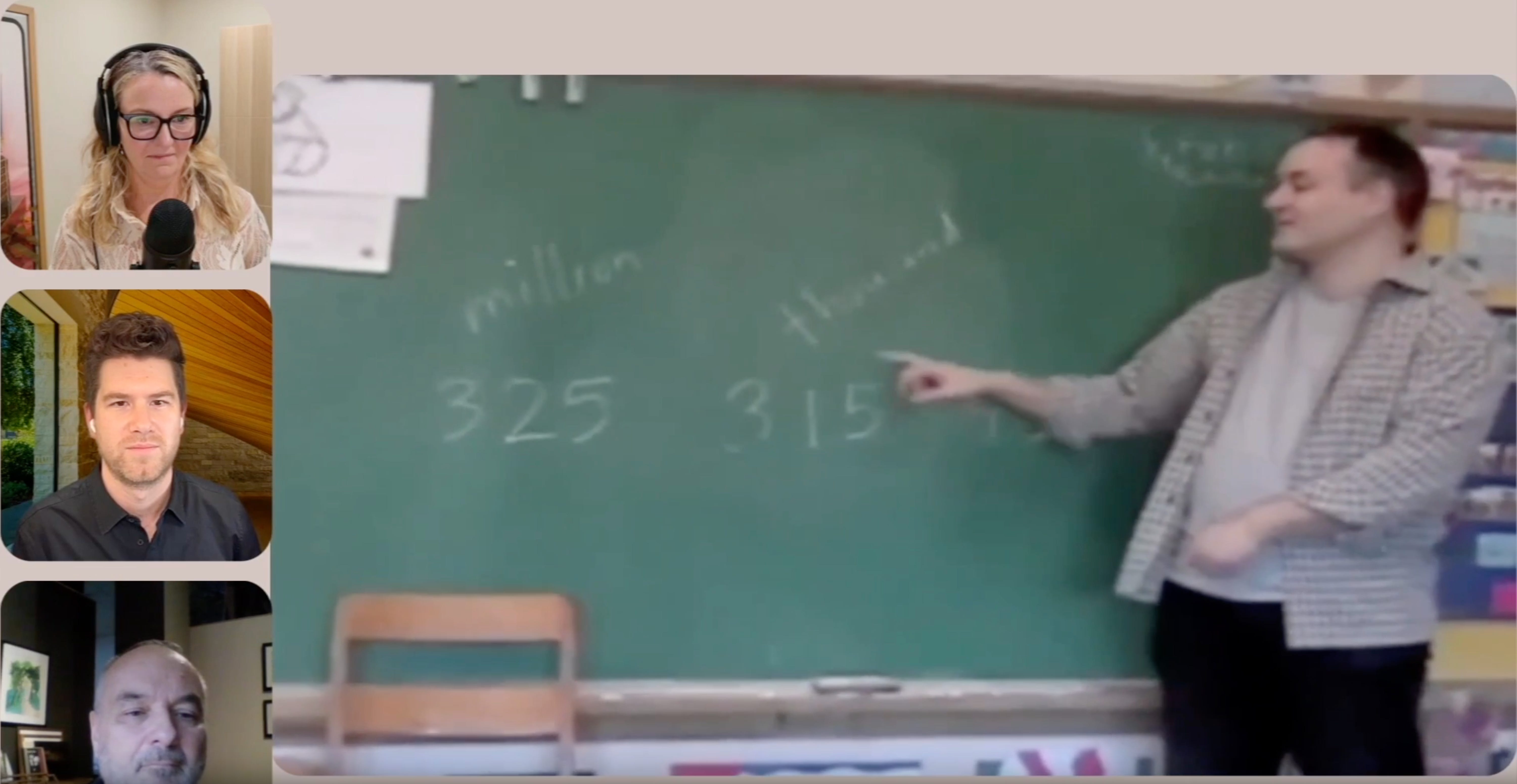
In this episode of Chalk Dust, Rebecca Birch and Nathaniel Swain are joined by renowned mathematician, educator and founder of JUMP Math, John Mighton. Drawing on classroom footage from Canadian primary classrooms, John shares the instructional principles that underpin his work: breaking complex ideas into manageable steps, ensuring every student experiences success, and building confidence through carefully sequenced learning.
The discussion explores the relationship between motivation and achievement, challenging the idea that some students are simply “maths people” while others are not. John argues that confidence is not a prerequisite for success but a consequence of it. Through examples from lessons on place value and long division, he demonstrates how micro-scaffolding, structured inquiry, and deliberate practice can help students tackle sophisticated mathematical ideas while remaining engaged and optimistic.
Throughout the episode, Rebecca, Nathaniel and John discuss the role of challenge, the importance of maintaining students in an optimal learning zone, micro-scaffolding, and how effective teachers create classrooms where every learner can participate in meaningful thinking. The conversation extends beyond mathematics into broader questions about motivation, differentiation, classroom culture and what it means to teach with both precision and humanity.
Mentioned resources and explainers
John Mighton
John Mighton is a mathematician, playwright and educator best known as the founder of JUMP Math. His work focuses on making mathematics accessible to all students through carefully sequenced instruction, micro-scaffolding and high expectations. His books can be found here, here and here.
JUMP Math
JUMP Math is an instructional approach and curriculum developed by John Mighton. The model emphasises breaking learning into small achievable steps while maintaining conceptual understanding and challenge.
The 85% Rule
A principle discussed by John suggesting that learners are most motivated when they are successful most of the time, but still experience enough challenge to stretch their thinking. The goal is to avoid both frustration and boredom.
Structured Inquiry
Rather than choosing between explicit instruction and discovery learning, structured inquiry carefully guides students towards important insights through well-designed questions, examples and prompts.
Micro-Scaffolding
A teaching approach that breaks complex concepts into very small, manageable components so that students experience repeated success while building towards sophisticated understanding.
Collective Confidence
John discusses how confidence can become a collective classroom phenomenon. When students repeatedly experience success and see their peers succeeding, expectations about who can learn begin to change.
Deliberate Practice
The idea that expertise develops through carefully designed practice targeting specific areas for improvement. John discusses how this principle influenced his thinking about mathematics instruction.
The End of Ignorance
John Mighton’s book exploring mathematics learning, intelligence, and the belief that far more students can succeed in mathematics than is commonly assumed.
Listen or view, and support our work
📨 Substack — sign up
🍏🎧 Apple Podcasts — like, review and follow
🎵💚 Spotify — follow and rate
📺🔔 YouTube — subscribe and like
✍️ Rebecca’s Substack — read more
✍️ Nathaniel’s Substack — read more
Takeaways
Confidence often follows success rather than preceding it.
Mathematics learning can be transformed through careful sequencing and micro-scaffolding.
Students are most motivated when challenge sits just beyond their current level of mastery.
Structured inquiry offers a middle ground between direct instruction and pure discovery learning.
Small successes accumulate into powerful changes in student identity and motivation.
Effective teachers reduce unnecessary barriers while maintaining high expectations.
Differentiation does not have to mean different outcomes for different students.
Whole-class participation helps build collective confidence.
Conceptual understanding and procedural fluency can be developed simultaneously.
Teachers should think carefully about the size of the steps between learning tasks.
Classroom culture is shaped by what students experience themselves capable of doing.
Mathematical talent is often far more malleable than commonly assumed.
Deliberate practice principles have important implications for classroom teaching.
Motivation and learning are deeply interconnected.
Great teaching often looks simple because the complexity has been carefully designed behind the scenes.
Keywords
John Mighton, JUMP Math, mathematics education, micro-scaffolding, structured inquiry, explicit instruction, deliberate practice, confidence, student motivation, mathematics teaching, classroom culture, differentiation, collective confidence, place value, long division, cognitive science, instructional design, mathematics learning, teaching strategies, Chalk Dust podcast